

Santa Lucia al Sepolcro and Caravaggio
 40 minutes
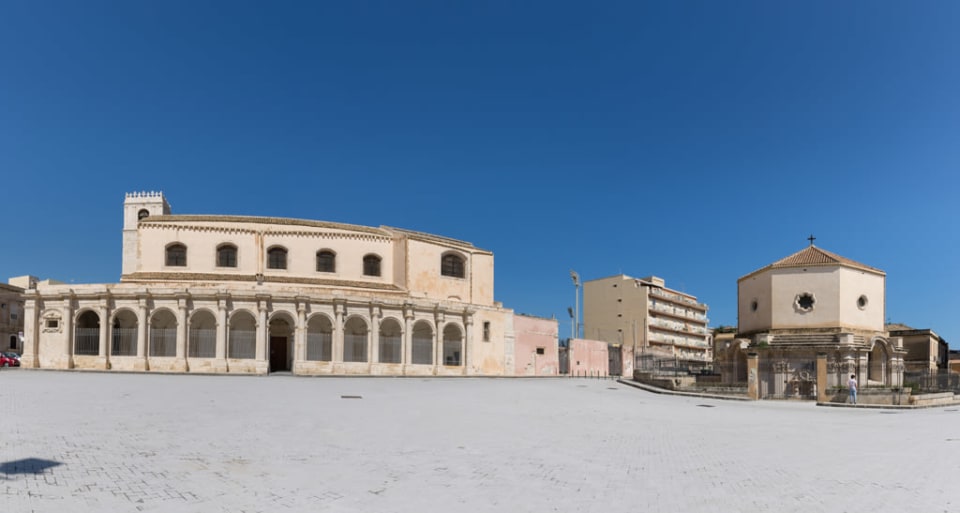
You start from the church most linked to the city's patron: the basilica of Santa Lucia al Sepolcro, also known as Santa Lucia Extra Moenia, meaning "outside the walls". It stands where, according to tradition, the saint was martyred in 304. From the 12th century construction, the façade, the portal, and the lower part of the bell tower are preserved; the rest belongs to later periods. Inside, behind the altar, is the Burial of Santa Lucia by Caravaggio, painted in 1608. It returned here on 6 December 2020, after years spent at Santa Lucia alla Badia, in Ortigia. Next to it is the Tomb of Santa Lucia, a semi-buried octagonal temple with the reclining statue of the saint, from 1634. Below the basilica are also the catacombs of Santa Lucia.
Tip
Visiting hours vary, and the catacombs have separate hours: check before you go. Shoulders and knees covered.
The Sanctuary of the Madonna delle Lacrime
 30 minutes
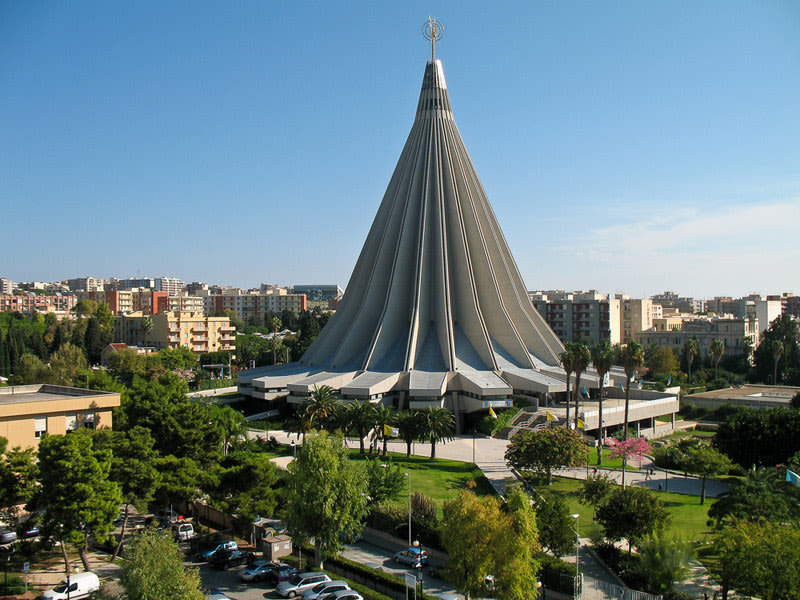
Not far away is the basilica sanctuary of the Madonna delle Lacrime, a very modern building. It was built between the Sixties and Nineties of the twentieth century to commemorate an event that occurred in 1953: according to the story, a small plaster statue of the Madonna in a house in Syracuse would have cried for several days, and the tears were analysed and found to be compatible with human ones. The shape resembles a large tear: a conical structure of reinforced concrete, with a crypt (the lower temple) and a basilica (the upper temple) that can accommodate up to 11,000 people. The crypt houses the statuette and is located above the remains of a pagan hypogeum.
Tip
View the sanctuary from afar and up close: the shape changes a lot. The crypt is not always open: check.
San Giovanni alle Catacombe and the crypt of San Marciano
 60 minutes
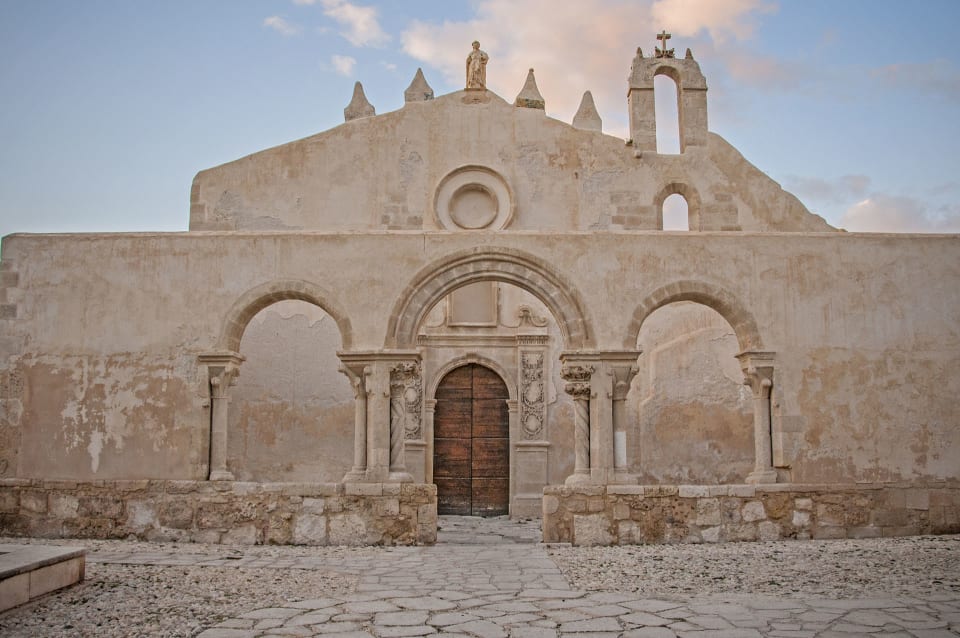
Here you enter the underground Syracuse. The church of San Giovanni, also known as San Giovanni alle Catacombe, has paleochristian origins and its current appearance dates from the 13th-14th centuries. Today it is roofless and hosts outdoor functions: the counter-façade with the large rose window and the columns that divided the naves remain. Below the church is the crypt of San Marciano, carved from a quarry and considered one of the oldest Christian churches in the West: it houses the tomb of the saint, who according to tradition was the first bishop of Syracuse. The catacombs of San Giovanni, built in the 4th century, are among the most extensive after those in Rome. The main corridor, the decumano massimo, is nearly one hundred metres long and from there five areas open up; there are about ten thousand burials. Don’t miss the refrigerium, an ark carved into the rock with three holes in the cover: they were used to pour wine, milk, and honey for the deceased.
Tip
Visits are only with a guide, at fixed times, and the church closes at certain times of the year: check beforehand. It stays cool even in summer.
Latomia del Paradiso and the Ear of Dionysius
 45 minutes
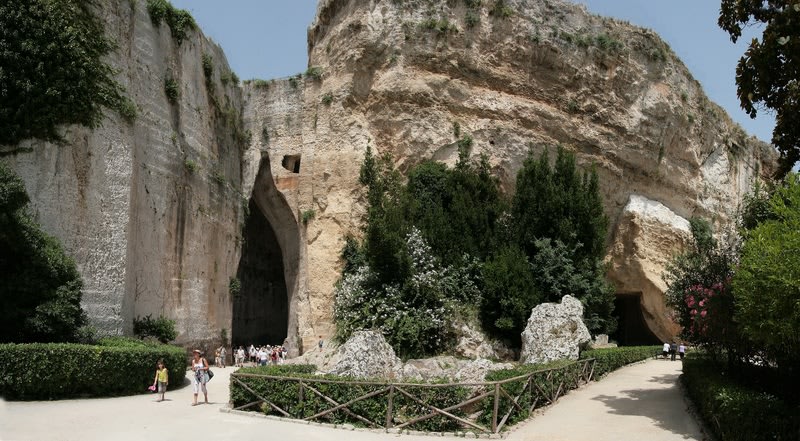
You enter the Archaeological Park of Neapolis, the heart of ancient Syracuse: the "new city" that grew mainly between the 5th and 3rd centuries BC, when Syracuse was one of the most powerful cities in the Mediterranean. The Latomia del Paradiso is a large stone quarry, up to 45 metres deep, used in Greek times also as a prison. Today it is a garden with lemons, oranges, olives, palms, and pomegranates. Inside it is the Ear of Dionysius, an artificial cave 23 metres high and about 65 deep, shaped like an S and with exceptional acoustics. It is said that the name was given by the painter Caravaggio in 1608; the legend of the tyrant Dionysius listening to prisoners from outside has never been proven.
Tip
Enter the cave and go all the way to the end: in the dark, the sound feels different. Check hours and access: certain parts of the caves may be closed.
The Greek Theatre
 30 minutes
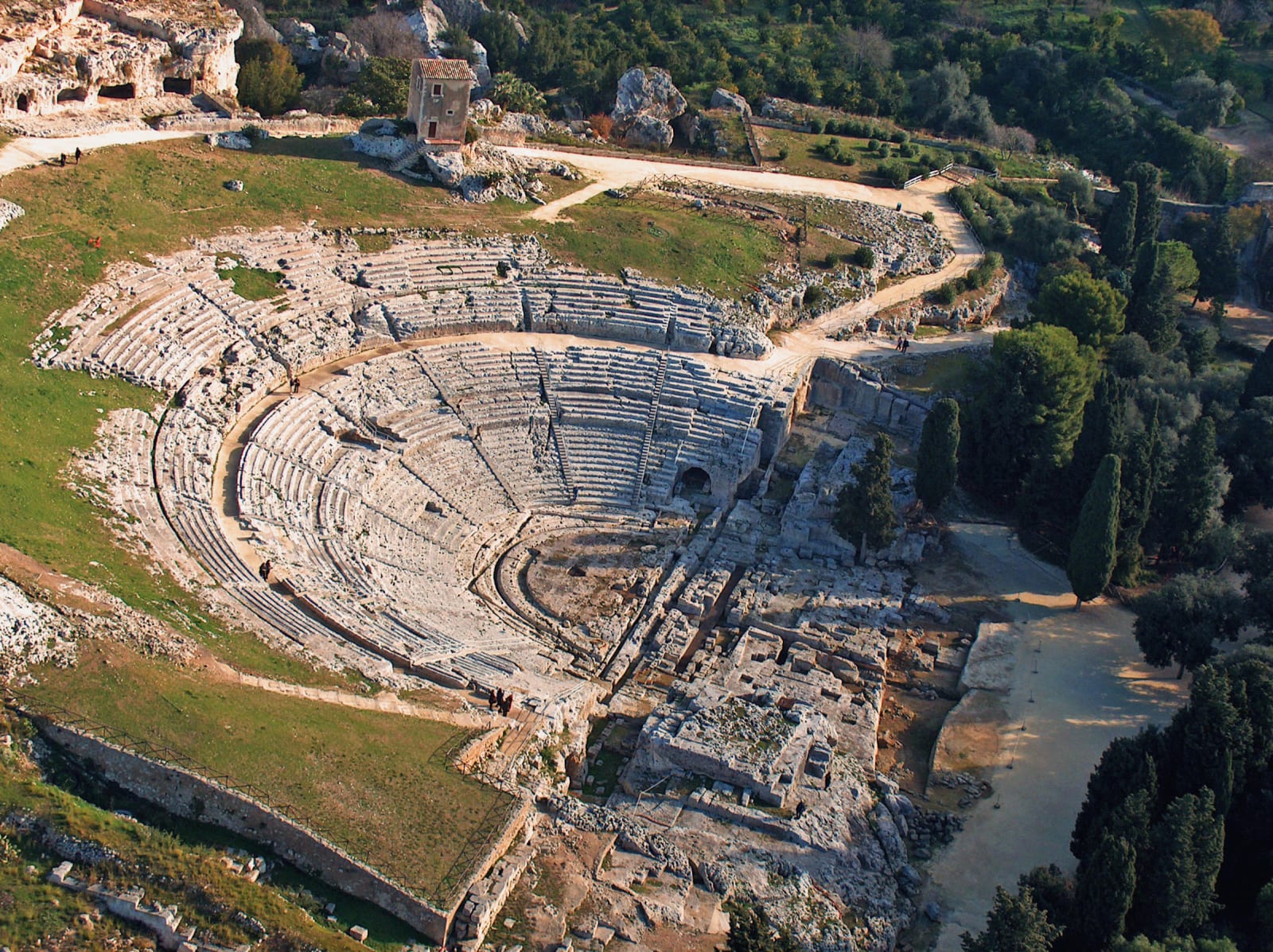
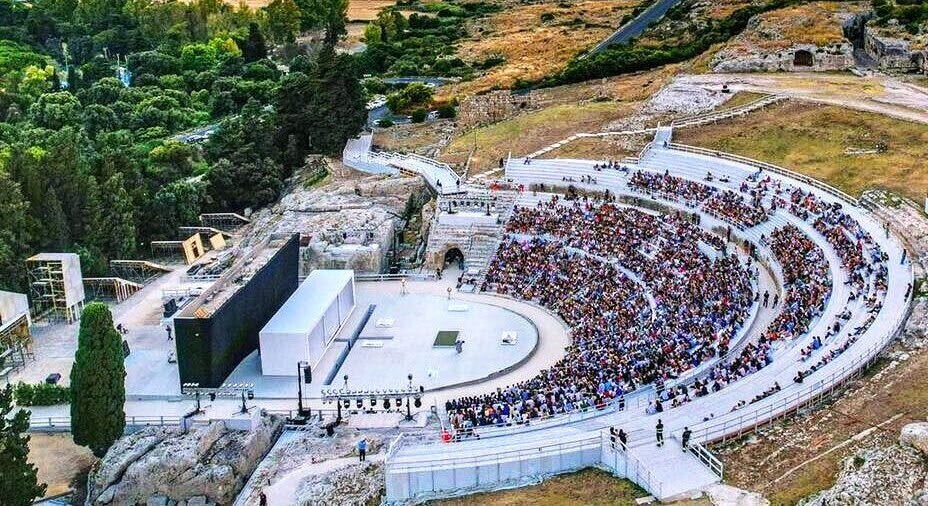
The Greek Theatre is one of the largest in the Greek world. The current theatre is the result of an expansion in the 3rd century BC, commissioned by Hieronymus II, of an older theatre from the 5th century BC. The cavea, carved into the rock, has a diameter of about 138 metres and originally had 67 rows of seats. Little remains of the upper part and the scenic building: the stones were reused in the fortifications of Charles V in Ortigia, in the sixteenth century. Every year, between May and June, the theatre returns to its ancient function, with the classical performances of the INDA, which have been held here since 1914.
Tip
In the months of performances, the theatre may be largely covered by the set-ups: if you want to see the seats, check beforehand or choose another time.
The Via dei Sepolcri and the Grotta del Ninfeo
 20 minutes
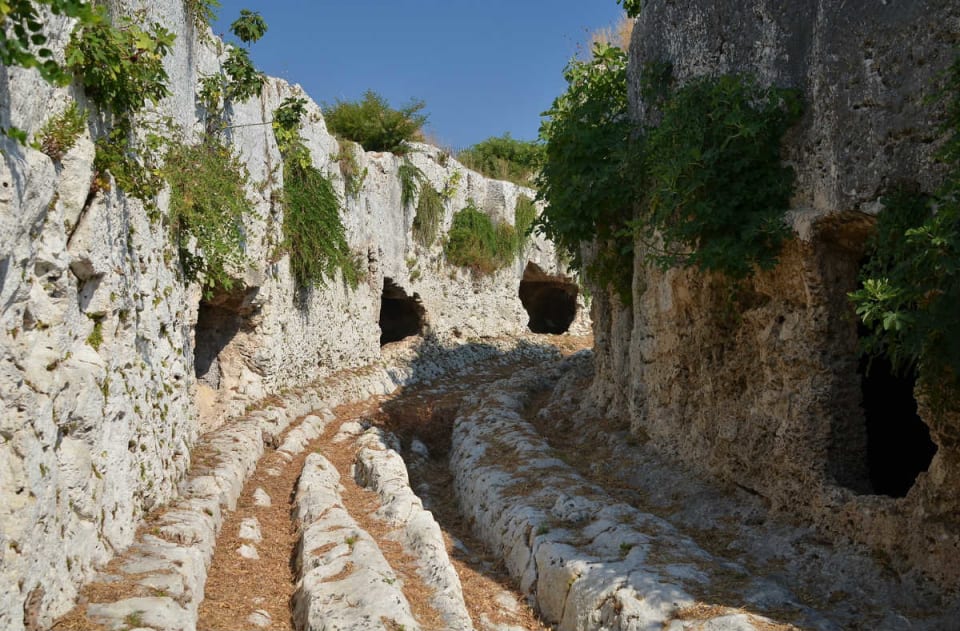
Above the theatre lies Via dei Sepolcri, a road carved into the rock, approximately 150 metres long and lined with Byzantine tombs. The ground is marked by the ruts of carts that passed through here to reach the water mills of the Spanish era. Along the way, you will encounter the Grotta del Ninfeo, at the highest part of the park: a fountain inspired by the Greek cult of nymphs, carved into an artificial cave. It was once adorned with statues dedicated to the muses of the 2nd century BC and was the meeting point for actors before descending to perform in the theatre.
Tip
This is one of the quietest parts of the park: stop to look at the ruts of the carts in the pavement.
The Altar of Hiero II
 20 minutes
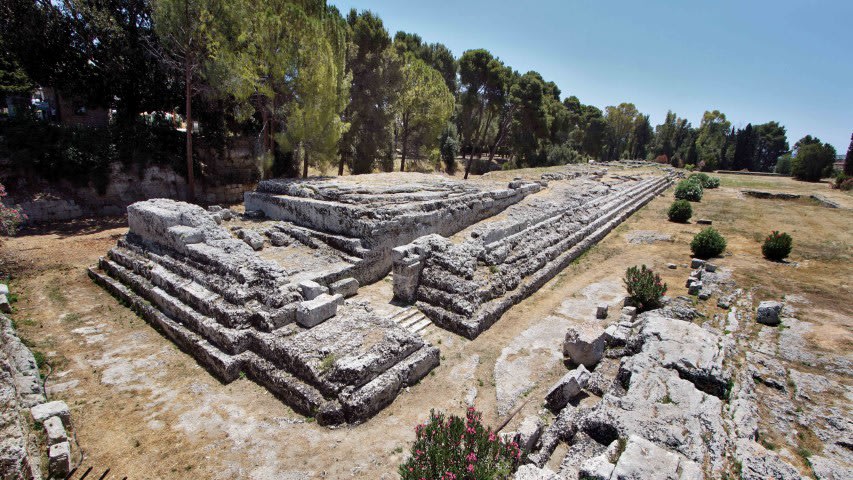
The Altar of Hiero II, built in the 3rd century BC, is the largest known altar of the Greek world. Only the base remains, carved into the rock, measuring 198 metres long and about 23 wide: it was used for sacrifices in honour of Zeus Eleutherios, and during festivals, it is said that up to 450 bulls were sacrificed at once. Imagine a large platform with two decorated access ramps: today, you can see the rock emerging from the vegetation, but the dimensions are well understood by walking along the edge.
Tip
Walk along the entire base: it’s the only way to realise how long it is.
The Roman Amphitheatre
 30 minutes
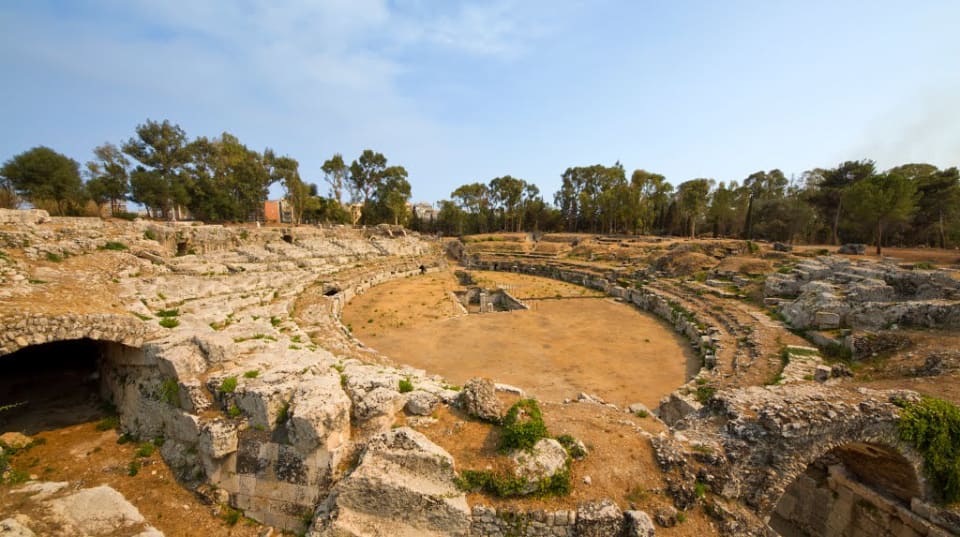
Just beyond the Altar is the Roman Amphitheatre, from the Roman era and one of the largest in Sicily. It was built using a rock outcrop, where the ambulatory and the tiers were excavated. Unlike the Greek theatre, here you can walk all around. The arena is elliptical and was accessed from eight openings. In the centre, there is a control room, once covered, probably used for water games and to operate stage machinery. The tiers still show the reserved seats for the Syracusan nobles.
Tip
Climb to the highest tiers: the view of the arena is the best, especially in the evening.
The Latomia of Santa Venera, the Necropolis Grotticelle and the «Tomb of Archimedes»
 30 minutes
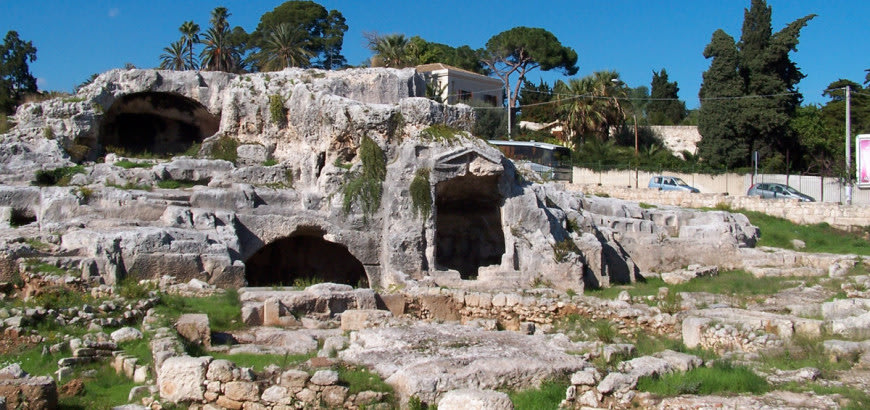
At the upper part of the park is the Latomia di Santa Venera, a subtropical garden from the 18th century, mostly visitable from outside for much of the year. Among the trees stands a huge Ficus macrophylla (the «pagoda fig»), a specimen several centuries old. A little further on, the Necropoli Grotticelle is a true city of the dead, with burials dating back to the Bronze Age. It reached its maximum expansion in the 3rd century BC and the Romans used it as a columbarium, with two tiers of niches for urns. In the easternmost part, you can see the so-called Tomb of Archimedes: a large chamber carved into the rock, with a pediment and relief Doric half-columns. It is not the mathematician's true tomb, but a tribute to him.
Tip
Arrive while there is still light: the higher areas of the park are less frequented and the late afternoon light is very beautiful.
Route map
On phone and tablet: one finger scrolls the page, two fingers move the map.
Frequently asked questions
For the Archaeological Park of Neapolis, you need two or three hours. With the churches and catacombs, you need a whole day. Ortigia has its own itinerary.